

Cycling helmets with Mips
11 March 2026
At BBB Cycling we are always searching for ways to make your ride more comfortable. We use functional solutions to reach this goal and want you to be secure of a safe ride when it comes to helmets. Therefore we have chosen to collaborate with Mips®. In this article we tell you all about the system, starting with what Mips® actually is.
The Multi-directional Impact Protection System (Mips®) is designed to add protection against rotational motion (or kinematics) transmitted to the brain from angled impacts to the head. This means that the helmet will protect your head better to impact from angles. Let's be honest, who falls from his bike in a straight line to the front, right? When an accident occurs most people will fall down with a rotational motion. This is a combination of rotational energy (angular velocity) and rotational force. Mips® added protection system has been proven to reduce rotational motion when implemented in a helmet by redirecting energies and forces otherwise transmitted to the brain. Mips® is an additional layer to a helmet and thus makes the helmet even more safe.
Mips® is a brain protection system
1. When you hit your head in a fall, it often creates a rotational motion in your brain.
2. The rotational movement can cause not only head injuries but also severe damage to the brain.
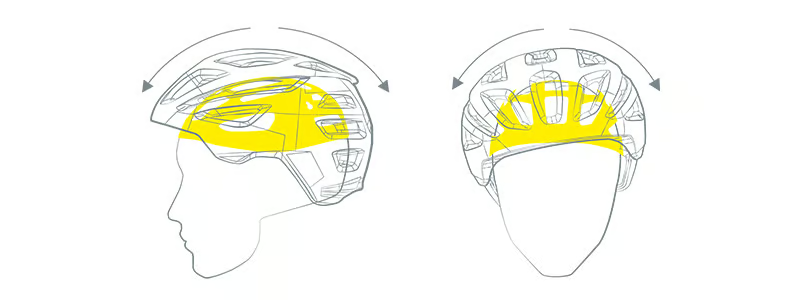
3. The Mips® low friction layer within our BBB helmet allows the head to move 10-15mm, in all directions, inside the helmet which reduces the rotational motion to the brain.
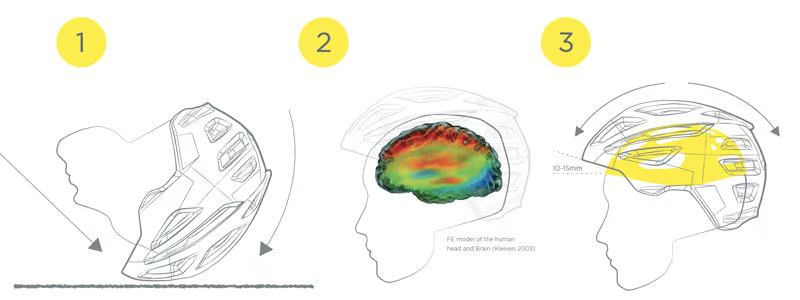
What is an angled impact or rotational motion to the head?
Everybody wants to avoid any accident from happening, but when you fail it will be with an angled impact. This means that you hit your head on the ground at an angle, not in a straight vertical drop to the ground. When you fall and hit the surface at an angle you can expose the brain to rotational motion. When the helmet impacts the ground at an angle the helmet and the head could start to rotate if the friction is high enough. Since the brain floats in the low friction layer within the helmet (or in the cerebrospinal fluid) it can move slightly. Rotational force can cause the brain to move suddenly and with significant force, which can cause stretching, twisting, or tearing in the brain. When the helmet twists along the angle of the fall this rotational impact declines.
Why is rotational motion dangerous?
It is known that the human brain is more sensitive to rotational motion than linear motion. Rotational motion is a combination of rotational energy (angular velocity) and rotational forces (angular acceleration) that affect the brain and increase the risk for minor and severe brain injuries. The brain is more sensitive to rotational motion due to the fact that it is very much like water or a gel when it comes to its shear properties. The brain, like water, is also incompressible. Therefore, a linear motion will not affect the brain as much as a rotational motion.

Where can I see my Mips® layer?
When you look inside one of our helmets, you can usually see the low friction layer under the comfort padding. It’s usually yellow or/and marked with an Mips® logo. However, the low friction layer is always adapted to the helmet and its purpose, so it may vary from helmet to helmet.

Mips® Air Node
A different Mips® application is featured in our ultra lightweight Karma Mips® helmet. The Mips® Air Node system is designed for highly ventilated, lightweight helmets. A low-friction layer is laminated onto the comfort padding, and connected to the energy-absorbing liner with nodes of hook-and-loop fabric touch fasteners. At angled impacts, the nodes release locally, allowing the padding to slide, with the intention to help reduce rotational motion. The system adds practically no extra weight or volume.